
Software

P
Combined EXAFS and XRPD data analysis with EXAFS full multiple scattering calculations and whole-spectrum fitting. A code designed to maximise the usefulness of the EXAFS technique in the investigation of crystalline materials which powder diffraction (PD) methods could not uniquely resolve. The program retains many of the features of EXCURVE (s. the related web pages) and provides most of the PD features of the program GSAS. For EXAFS this includes full multiple scattering calculations and whole-spectrum fitting, but at present it cannot deal with EXAFS polarisation dependence. PD calculations currently exclude calculation of the thermal diffuse scattering contribution, which is included in the background.

PDFgetX3
PDFgetX3 is a command-line utility for converting X-ray powder diffraction data to atomic pair distribution functions (PDF) in automated batch processing. The interactive mode provides complete access to all parameters and intermediate results, as well as live-plotting feature for parameters tuning and visualization of their effects on the results. PDFgetX3 can be used either as a standalone application or as a Python library of PDF-processing functions.
Phenix
PHENIX is a software suite for automated macromolecular structure determination that can rapidly arrive at an initial partial model of a structure without significant human intervention, given moderate resolution and good quality data. This has been made possible by the development of novel algorithms for structure determination, maximum-likelihood molecular replacement (PHASER), heavy-atom search (HySS), template and pattern-based automated model-building (RESOLVE), automated macromolecular refinement (phenix.refine), and iterative model-building, density modification and refinement that can operate at moderate resolution (RESOLVE, AutoBuild). These algorithms are based on a set of crystallographic libraries that have been built and made available to the community.

Phonon
PHONON is a code to calculate lattice dynamics, mainly using input force constants from ab initio (DFT) codes like VASP. There are many kinds of output including spectroscopic scattering functions.

pni-libraries
The PNI libraries are a stack of related C++ libraries developed with the intention to simplify the development of scientific software in the field of Photon-, Neutron, and Ion-scattering.

Ptychography Alignment Tools
This project provides a PyQtGraph-based GUI to assist users on the alignment of Ptychography scans. The tool has the following features: -Load set of images (tiff files supported) -Select pairs of images for alignment -Import/Export probe positions (npy array) -Image controls: levels, contrast, look up tables, zooming, translation -Preview the global picture by combining all positions

PtyPy
Framework for scientific ptychography including suitable classes for many concepts of ptychography

PyFAI
pyFAI is an azimuthal integration library that tries to be fast (as fast as C and even more using OpenCL and GPU). It is based on histogramming of the 2theta/Q positions of each (center of) pixel weighted by the intensity of each pixel, but parallel version uses a SparseMatrix-DenseVector multiplication

PyHST2
Hybrid distributed code for high speed tomographic reconstruction with iterative reconstruction and a priori knowledge capabilities. PyHST2 (formerly known as PyHST) has been engineered to sustain the high data flow typical of the third generation synchrotron facilities (10 terabytes per experiment) by adopting a distributed and pipelined architecture. The code implements, beside a default filtered backprojection reconstruction, iterative reconstruction techniques with a-priori knowledge. The latter are used to improve the reconstruction quality or in order to reduce the required data volume and reach a given quality goal. The implemented a-priori knowledge techniques are based on the total variation penalisation and a new recently found convex functional which is based on overlapping patches.
PyMca
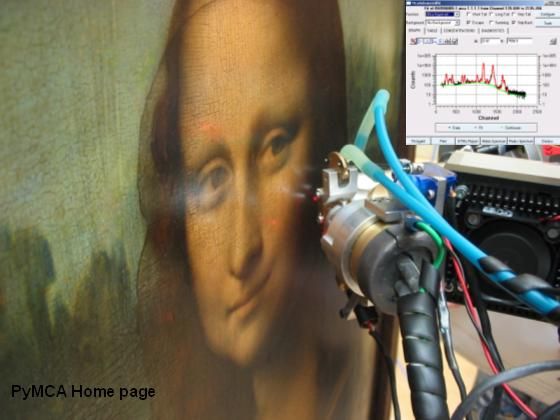
X-ray Fluorescence Toolkit (visualization and analysis of energy-dispersive X-ray fluorescence data). . The program allows both interactive and batch processing of large data sets and is particularly well suited for X-ray imaging. Its implementation of a complete description of the M shell is particularly helpful for analysis of data collected at low energies. It features, among many other things, the fundamental parameters method

PyNX
Python toolkit for accelerated Nano-structures Crystallography and Coherent X-ray Imaging techniques. The software included in this package can be used for: 1. the computing of X-ray scattering using graphical processing units 2. X-ray wavefield propagation (from near to far field) 3. simulation and GPU-accelerated analysis of experiments using the ptychography and coherent diffraction imaging techniques See the full documentation at: http://ftp.esrf.fr/pub/scisoft/PyNX/doc/

Quantum Espresso
Quantum ESPRESSO (QE) is an integrated suite of Open-Source computer codes for ab initio quantum chemistry methods of electronic-structure calculations and materials modeling at the nanoscale. It is based on density functional theory, density functional perturbation theory, plane wave basisi sets, and pseudopotentials. The core plane wave DFT functions of QE are provided by the PWscf (Plane-Wave Self-Consistent Field) component,
Quanty
Quanty is a script language which allows the user to program quantum mechanical problems in second quantization and when possible solve these. It can be used in quantum chemistry as post Hartree-Fock or in one of the LDA++ schemes. (self consistent field, configuration interaction, coupled cluster, restricted active space, ...) The idea of Quanty is that the user can focus on the model and its physical or chemical meaning. Quanty takes care of the mathematics.

ROD
ROD is a program that can be used to do a refinement of a surface structure using surface X-ray diffraction data. All main features one encounters on surfaces, like roughness, relaxations, reconstructions and multiple domains, are taken into account. The most essential part of ROD is the calculation of the structure factor of the surface. ROD is complemented by two utilities: ANA and AVE: ANA can be used to integrate scans and to convert these into structure factors, while AVE can sort and average data, determine agreement factors and produce a data file for the program ROD.

SASfit
SASfit has been written for analyzing and plotting small angle scattering data. It can calculate integral structural parameters like radius of gyration, scattering invariant, Porod constant. Furthermore it can fit size distributions together with several form factors including different structure factors. Additionally an algorithm has been implemented, which allows to simultaneously fit several scattering curves with a common set of (global) parameters. This last option is especially important in contrast variation experiments or measurements with polarised neutrons. The global fit helps to determine fit parameters unambiguously which by analyzing a single curve would be otherwise strongly correlated.